
Blain’s Morning Porridge, May 27th, 2026 – Record US Stock Markets But Something Ain’t Right?
And what rough beast, its hour come round at last, slouches towards Bethlehem to be born?
You can’t keep a good market down. New record US levels seem to occur daily. But, why? The underlying picture of the US economy is not weak, but the political structures around it seem to be fraying. What might give and trigger the kind of reversal many expect, or might we get a more fundamental reassessment of what the USA will look like post-Trump?
Joy unbounded in markets! Stock markets have hit new record levels – yet again. If you were to snapshot the US economy – what’s not to like? The AI everything boom and the promised productivity gains are driving sentiment higher. Employment numbers are generally solid. Growth is decent. Corporates are doing well with rising outlooks. And the when the stock market is strong – well, that’s a great sign of confidence in the economy and its leadership.
The US President would certainly claim so…
Why do I have a gut feel a crisis is coming. Its more than just rising inflation fears, or consumers struggling with a 50% hike in gas prices. Talking with American chums, I get the sense they are increasingly worried about stability and sustainability in the debt markets. In bonds there is truth – which we shall come to below.
After 40 years in markets, I am acutely aware the most fun in markets is to be had just before the end of the party. I’ve seen bubbles pop, and credit wobbles become global crises. I know enough to know the causes are never simple, and how crisis seldom begins in the places you’d think to look. The worst crises are no-see-ums. Yet, I am watching AI, Private Credit, Private Equity and Geopolitics to understand what is about to break.
Who knows… I have a cheeky bet markets will reverse soon after the Second Coming many expect the SpaceX IPO to be!
My spidey senses are tingling, telling me things are increasingly out of kilter, and to understand why means deciphering the bigger picture. Imagine a 10,000 piece jigsaw, still in its box, and trying to put it together in your head to describe the current threat. What I conclude is that common sense has become a very uncommon commodity these days. In overly exuberant markets, Wisdom is in very short supply.
Let me try to put it up on a threat board:
Iran
The risk of global recession from the consequences of Iran on energy prices remains very real. Even if a hard-stop is declared and the straits were to reopen tomorrow, Capital Economics point out will take months, probably into next year, before global oil supplies normalise due to issues such as tankers being “offside”, doing other routes.
Iran has cost the USA dear. The bill for 89 days of on/off war is at least $50 bln. It has demonstrated the US style of precision warfare consumes war-stocks at a frightening and unsustainable rate, and exposing the shortage of US carrier groups. The President has put a demand for a $500 bln increase for the “War” Department on the table. The Chinese will have watched carefully and learnt much – secure in the knowledge their own armouries remain full (and their anti-aircraft weapons weren’t revealed). Estimates suggest Iran still has much of its missile armoury ready to resume regional attacks – a critical factor in the current “negotiations”.
Gulf states are increasingly distancing themselves, making deals directly (Qatar), and silent on resuming Abraham peace accord talks with Isreal. In asymmetric warfare Iran can out-wait the US. The Gulf states cannot.
There is no clear US exit that doesn’t look like humiliation. Iran has been described as America’s Suez moment, and thus its’ whole Middle East strategy is in danger of unravelling. The recent summit in Beijing cost the US global credibility, which now flows China’s way, raising the expectation of hegemonic change – and new geopolitical partnerships.
The problem: Iran threatens to become a definitional moment of failure for the USA – which will tarnish its competency to remain global hegemon. It has confirmed to the world the US President lacks Wisdom. He has proved himself no deal-maker. Venezuela marked peak-Trump – when the rest of the World and America’s former allies still felt the USA was so powerful that the President had to be placated on whatever he demanded. Now, Iran leaves the US military “tired” and undersupplied, while the President is seen a busted flush who will become increasingly irrelevant. How aggressively China moves into the Gap opened by the President’s foolishness remains to be seen.
US Politics
The last few days have seen The President increase his grip on the MAGA (formerly Republican) Party. He has wielded his endorsement to force out two perceived RINO (Republican in name only) sitting senators, replacing them with MAGA loyalists. Among hard-core MAGA supporters, the President’s vote remains strong, but across the nation his approval levels have tumbled. Only 34% of American’s approve of the war, and only 22% think he is handling the cost-of-living crisis well. “It’s all about the economy, stupid!” What’s unclear is how non-MAGA Republicans voters may try to reverse Trump’s capture of conservatism by siding with the Democrats in the midterms.
The problem: The probability markets now say there is an 80% likelihood the Democrats take the House (Congress) in November, and a 50% chance they take the Senate also. That will leave Trump “lame-ducked” and likely lead to increased political polarisation, raising the possibility of internal succession battles to determine Trump’s successor in MAGA. With DC distracted and infighting, US political competency to resolve budgets and address challenges could become an increasing issue for global investors.
US Markets
I flipped open the US national debt clock this morning. It is the most frightening page on the internet. It says $39.15 trillion with the other numbers spinning to fast to read. Yesterday a headline flipped up – Trump Responsible for 28% of US debt. In his 5-years and 4 months in office, Trump has added nearly $9 bln to the National Debt through tax cuts and spending (although $3.5 bln of that was Covid related). Strip away the Covid, and he is likely to outspend any other president. Economists now say the effects of last year’s Reverse Robin Hood (take from the poor, give to the rich), Big Beautiful Bill are now fading – suggesting a combination of higher rates and declining consumption could hit profits.
The success of the US economy in invention, innovation and the growth of world leading firms and industries is largely due to the strength and liquidity of its Capital Markets. US Firms have successfully exploited that pot to achieve global growth and market dominance – especially in Tech. For the last 20 years US capital markets have funded American corporate exceptionalism, allowing the acquisition of vast swathes of European early-stage firms – leaving European markets thin and shallow, while US Private Equity milks the markets. The lack of European industrial or commercial drive may largely be a consequence of the success of American markets.
US capital dominance has largely happened since the Global Financial Crisis of 2008. While European banks were hamstrung by Draconian new lending and capital constraints, US banks were swiftly unleashed and now dominate global finance. Their strength has funded the extraordinary capital demands of the AI sector to build out infrastructure.
The rest of the world is learning. Europeans are now hesitant to buy US defence goods – no longer trusting the US President on Nato. European airlines would rather fly Airbus – because they saw first-hand how Boeing treated non-Americans during the B-737 Max debacle. (O’Leary of Ryan Air doesn’t care – he see’s antipathy towards the US as an opportunity to buy cheaper!)
Global firms are looking at the escalating costs of US Hyperscale Closed-Source LLM Models where they give up all their data to US firms so they can rent it back? And they are wondering if cheaper, as good, and open-weight Chinese AI might be better? As discussed in the Porridge multiple times, AI is still evolving as a business proposition. The American all-singing, all dancing LLMS are not the only answer. Chinese AI may not be perfect (for multiple reasons) but its more competitive, adaptable and cheaper than US equivalents.
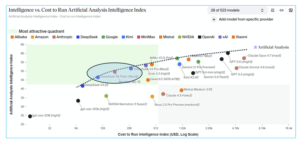
The attached (sorry its fuzzy) chart show Model intelligence vs cost to run. DeepSeek dominates the favours North-West quadrant.
The problem: What would happen to the US economy without Western defence orders, and a shift to Chinese tech? How profitable can the AI revolution be if China wins a significant share? What would happen in US Treasuries become unsustainable on the back of rate hikes and a reduction in exorbitant privilege as the dollar becomes a less favoured currency in new Chinese/South Asia hegemonic world? What would happen if US capital markets were closed by a no-see-em crisis in credit or a AI bubble burst?
This morning I’ve touched on just a few of the issues that have been brought to the fore in recent months: the President’s mistake in Iran, the perilous state of the US debt markets, and the possibility of a AI bubble and a slowdown in demand for US goods and services impacting across the whole economy. I am sure there are more things to be equally concerned about – the structural vulnerabilities of the private credit markets, the potential of a sustained energy shock, or even a series of climate events. (This week London is sweltering in sustained record May temperatures.)
This could become an example of a magnified Virtuous Sovereign Trinity (“VST”) event. Under the VST theory any nation with a stable currency, a sustainable bond market and political competency will do well. Trump has now demonstrated a lack of credibility, and called the competency of his administration into question even as the debt pile soars, and allies look to de-dollarise. Without the trillions of dollars in banks from global trade (denominated in US$), then think how much wider US yields would go, and how that would impact out of control spending on AI infrastructure…
I would also cite the rampant corruption now emerging in the Trump economy. I’ve been told its not true… really? Fish, and economies, rot from the head down.
Out of time, back to the day job…
Bill Blain
Author of the Morning Porridge
CEO Windshift Capital
Advisor – Spitfire Strategic Capital
Meanwhile, don’t forget about my new book:
The Battle For Hamble is a proper grown-up examination of how bureaucracy has failed: a tale of Greedy Corporates, Bad Planning and Economic Illiteracy. It explains how a wholly unnecessary Gravel Quarry will be dug in middle of a prosperous village – putting 6000 jobs at risk. The truth is no one wants gravel, and the quarry company understands it’s not what you dig out, but what you stuff back into a hole in the ground that matters. Gravel sells for £30 a tonne – Landfill earns £150 a tonne to bury. Go figure.
4 Comments
Comments are closed.

Iran has been a rogue theocratic regimen for yrs. Destabilizing and threatening the entire Middle East.
They had never adhered to the Obama Nuclear deal.
After Gaza, it was clear Iran had heavily armed proxies on 4 sides of Israel. .
In 2025, the nuclear sites were destroyed but it became clear that more was needed.
What would you have suggested as alternative at that time?
As painful as this is, the situation needs to be finished
Agree that the situation in Iran needs fixed.
No one is disagreeing that Iran should not have nuclear weapons.
But the issue is how.
One of President Trump’s first actions was to unravel the Obama deal. It was never given the chance to change Iran from within – lifting sanctions, encouraging liberalism and leading it gently towards a new revolution easing the power of the theocracy and the re-emergence of Iran’s vast middle-class liberal society. Might not have happened – but the evidence from Eastern Europe and elsewhere suggests it would have. What I saw trying to deal with Iran in 2015 was a very corrupt society – desperate for opportunities to get rich by rejoining the world. They cared for dollars.. not Allah. It convinces me they could have been suborned.
Or, you could take the Trump approach. Which definitely hasn’t worked.
I’m in your camp generally about the risks we now face, but did an interesting search. Obama increased the debt by ~70% ($11T to $20T) and if you add Obama’s third term (ha ha ha)–that is, Biden-Harris–it added another $8T, so grand total of say $16T, that means that they alone added nearly 40% of the debt. My question is, if we go back to that kind of regime I don’t see any reason to think the debt numbers get managed any better. Just sayin’.
Well suicidal empathetic observation has not been effective for 47 yrs. And 11 yrs since JCPOA, THE sanctions were probably only slightly bothersome. They were trading around,thru.,under them thru proxies etc.
They managed to provide $100’s of billions to their proxies in arms and support. Gaza managed to build 300+ km of fortified tunnels full of missles. Drones, etc.
Where did that come selling olives??