
Blain’s Morning Porridge July 16th 2025 – Trump Surprises, but it still feels like a race to the bottom.
“I supped with the devil last night. He really is a most reasonable chap once you get to know him…”
Donald Trump’s BBC interview was… “surprising”. It was Trump, but elegiac? It won’t change the economic reality. The market is living in today – assuming the consequences of Trump policies will be limited. If they hit hard – which economy will suffer most? The USA or the UK?
Interesting chat with a US chum yesterday. We placed bets on which economy will emerge least damaged when the inevitable occurs:
- The UK, which is sinking into a slough of economic despond, despite the best-intentioned efforts of government to tinker around the multiple organ failures of the economy, or
- The US, where the chaotic unravelling of the economy’s basis is happening at disruptive speed and with increasing polarisation.
I reckon the UK… and will explain below…
Meanwhile…
Gary O’Donoghue is the BBC’s man in Washington. On Monday night he was napping when Donald Trump’s press secretary called him (yes, that one), and passed him straight to the President.. “Hi Gary…” It was a genuinely scary 20 min interview. Perhaps for all the right reasons.
Trump came across as normal (for an American, and an American President to boot), measured, thoughtful, even vulnerable at times. He talked openly and answered O’Donoghue’s questions with patience, a measure of grace, and without the malice we’ve seen him wield in public towards journalists asking difficult questions.
Hat-tip to O’Donoghue. The vision of the BBC’s portly Washington chief scrabbling round a hotel room to find a digital recorder is even more illuminating when you remember O’Donoghue has been totally blind since childhood.
O’Donoghue famously reported from the assassination attempt a year ago, and asked The President about it – Trump was genuinely uncomfortable to talk about it, not hiding anything but still figuring it out. His comments on not dwelling on the incident, and “the power of positive non-thinking” were genuinely reflective and considered.
A number of politicians have said Trump can be very reasonable and engaging in private. The interview displayed that in a way few Europeans will have previously seen. It may have all been a set up – part of a charm-offensive before he visits Britain and Europe. But it had an effect.
There were a number of key take-aways.
- He is frustrated with Putin – that should give Ukraine hope.
- He’s happy that he goaded NATO into action – and it sounds like he’s now looking to re-engage on a mutually beneficial basis with the USA as a key part of a re-invigorated Alliance.
- He likes the UK – (his mother is Scots.)
- Donald Trump is Donald Trump. He does it, and says it, different.
While the tone of the interview was quite extraordinary, the effects may be even more so. It may dial down the intense negatively many Brits and European’s feel towards Trump, opinions that have coloured sentiment towards America and how the new global geopolitical landscape is developing.
That said… Trump continues to pose a disruptive threat to global markets and economy. From an economic and market perspective… it ain’t over yet. In coming months, it is likely the consequences of Trump policies will start to bite.
These consequences may be less damaging than we fear – a point Trump supporters have been making in terms of the apparent resilience of the economy. Jobs are not crashing, inflation is only marginally higher. Yet.
Let me do some back of a beer mat, pub-maths. (Yes. Americans take note: it is Mathematics, therefore maths.)
- We know that Tariffs are already netting the US some $27 bln per month.
- If we assume Tariff income rises to $40 bln per month, that’s roughly 2.2% of total consumption – still enough to hit people’s pockets.
- Tariffs would account for about 10% of total US tax revues – a not insignificant gain to the government’s income.
Or, looked at differently, tariffs will be an additional sales tax on US consumers, and sales taxes are regressive, hitting the poorest hardest… MAGA pays.
The next battle is likely to be over who leads the Fed. Indications from Washington are Team Trump will seek to force Jay Powell to resign on “Trumped” up charges relating to the expensive renovation of Fed Buildings. Trump is openly calling the head of the Federal Reserve a “numbskull” because he won’t cut rates while the economy is strong, inflation is rising and jobs are tight.
Jamie Dimon is on the front page of the FT warning about the risks if the independence of the Fed is tested by Trump sacking him. I wonder if Dimon has political ambitions here – being a calm, rational voice of economic common sense. Which nomination has he his sights on ?
Back in the UK my invite to the Chancellor’s Mansion House speech got lost in the post again. Chancellor Reeves promised to cut City Red-Tape to trigger deal making to finance growth… but it’s all too late and too slow. Not her fault, but that train left long-time ago… it took centuries to build the City of London’s reputation, and only 17 years to over-regulate it into irrelevance.. (a repeating theme in the Morning Porridge since it started in 2007.)
So why then do I think the UK is essentially going to recover better than the US from the current economic end-game scenario?
I don’t think the perceived Gilt Threat is as dangerous as the overly nervy market believes. There is still belief in the UK’s economic competency – which is why today’s graph (again from ChatGPT and I still not sure I would trust it) of the 10-year Gilt Yield and Cable does not show panic. If there really was genuine concern the UK is about to enter a catastrophic crisis I would expect to see a more dramatic divergence as Gilt yields went stratospheric and sterling collapsed.
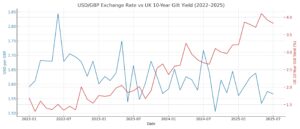
At the moment these two indicators of the UK’s “Virtuous Sovereign Trinity”: a stable currency, and a sustainable bond market, are reacting to market data, economics and news, but are not showing a breakdown in the market’s view of the UK’s ongoing political competency. If the crisis deepens, there a sound reasons the expect the UK’s unparallelled ability to “muddle through” will still kick in.
That’s not the outlook for the USA. The degree of political polarisation is increasing – making the likelihood of a concerted, coordinated response to a crisis feel questionable. While Trump surprised to the upside in the BBC interview, the US will not be in great shape to weather a crisis if it arrives if MAGA is fuming about inflation and Epstein, the Fed is in bits, and Scott Bessent is in hiding lest he gets blamed.
Just saying… it could get messy.
Out of time, and back to the day job…
Bill Blain
Author, The Morning Porridge
Partner Shard Capital
8 Comments
Comments are closed.

It will take more than a soothing interview with the BBC to calm the waters if he forces out the Chairman of the Federal Reserve.
Its comforting to hear the cautionary tone of Jamie Dimon but let’s not forget this man was Bernie Madoff’s banker. He knew precisely what Bernie was up to and said nothing.
Interesting experience developing with my efforts to use ChatGPT to generate charts. This week I’ve been testing it and sending a daily chart – and the data is unremittingly wrong. Trying to find out why?
Re AI data–there are some voices saying much of what these things are “using” as data is just what other AI has “collected.” I’m not an early adopter of tech in general, and most of what I’ve encountered is the top answer to some question or search on browsers. I think this may be a case where the “less is more” idea doesn’t work. In other words, we might have to really be specific and narrow in what we ask for? Also, if the data is behind a pay-wall (such as proprietary information in the Gypsum Association database) you’ll never get a good answer…
I’m still wary….
Perhaps they knew not to call it ChartGPT. As to why it is unremittingly wrong in your experiment, the answer on a superficial level must be the human programming of ChatGPT and of its “machine learning”. On a deeper level you would have to interrogate the human programmer.
human programmer? Is there one?
The negative correlation of USD per GBP and the UK 10-year is clear but an even better negative correlation would be expected between USD per GDP and the differential between the UK and the US 10-year gilt and treasury yields.
Let’s remember Trump is a world-class con artist. He has left a long trail of destruction of businesses, careers, and hearts for those who pledged to him their unrequited loyalty and trust. When I look at America’s sovereign trinity, I see check marks in the negative boxes for political competency, a stable currency, and a sustainable bond market, all three trending in the wrong direction. “I supped with the devil last night. He really is a most reasonable chap once you get to know him…” Yes, indeed.
You should ask ChatGPT why the multi-modal GPT models are so bad a creating accurate charts – I think the answer is pretty spot on!