
Blain’s Morning Porridge October 9th, 2026 – Trump’s Tax Cuts have walked the USA into Debt Trap
“Taxation is the price we pay to remain civilised.”
The US economy looks rosy – if you are looking at the fantabulous promises of the Stock Market. The reality is very different. The scale of the $40 trillion National Debt is a problem that will not just go away and puts substantial limits on how the US can respond to any new economic or conflict crisis without risking massive inflation. Underlying the scale of the debt is not just poor spending decisions, but tax cuts that have accelerated the debt crisis.
Key Takeaways:
- The pace of the rising US National Debt has massively outpaced the growth of the economy and tax revenues.
- Tax receipts, and how tax cuts have effectively increased the scale of the US national debt, are just as important as spending to the debt quantum as Government Spending.
- Trump’s two rounds of tax cuts in 2017 and 2025 have had major impacts on the outstanding debt but show limited effects in terms of triggering economic growth.
- Tax cuts have been Reverse Robin Hoods, favouring the wealthy over the poor – a contradiction to Trump’s promise to support those left behind by globalisation, foreign competition and industrial decline.
- Now the USA finds itself with an unsustainable debt pile which becomes more expensive as self-inflicted inflation rises and leaves it less able to respond to economic and conflict crises as global Treasury buyers look elsewhere.
- Inflating away the scale of the debt, as Trump has proposed, would be a disaster for the economy and likely trigger higher rates and destructive hyper-stagflation.
The front pages say it all this morning.
Open AI revenues disappointed to the tune of $20 bln, while Masayoshi Son of Softbank is asking Gulf investors for a further $100 bln to fund his AI investment thesis… (He’s already backed OpenAI to the tune of $65 bln.) Masayoshi’s brilliant, cunning plan is to buy firms and use AI to make them more profitable – which is exactly what the commercial world is struggling to do. Business has embraced AI – it’s made work better, easier, but it’s not entirely clear how it changes profitable firms into extremely profitable firms – especially in highly competitive markets where every firm is doing it. In other words, AI is just like a tax or any other fixed cost. You have to pay it to remain in the game!
Taxes are the main theme of the Porridge this morning.
Take a look at this chart.
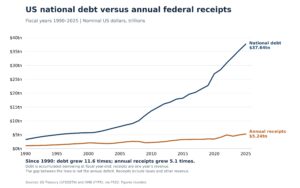
Very simple. It shows how the US National Debt has grown x12 since 1990, but tax receipts have only grown x5. The deficit is the rolling total of outstanding debt… tax receipts are the Government’s yearly income. Do you see why this might be a problem?
Yesterday there was a very significant piece in the FT written by Brendan Doyle: “We need a US debt conversation – will the Republicans have one?” He is a Democrat Congressman, and ranking member of the US’s Congressional House Budget Committee. He takes issue with the usual Republican excuses for America’s burgeoning $40 trillion debt. Republicans blame the scale of the debt on Spending. (Hence all the palaver about DOGE addressing bad spending… and what a joke that turned out to be.)
Doyle turned the Spending argument on its head, arguing its taxes, and major tax cuts over the last 25 years as a primary reason US debt has soared to levels where it’s now scaring the markets. Meanwhile, tax cuts favouring the wealthy are reflected in an economy that has become polarised in terms of politics and inequality. Since 2017, tax cuts have been Reverse Robin Hoods – benefiting the wealthy and large corporations at the expense of the poor.
In 1990 the US national debt was $3.2 trillion. Today it is $40.2 trillion. At the start of Trump’s first term, it was $19 trillion. In 10-years it has doubled. The largest single increase in debt was in 2020 primarily due to Covid. Interestingly, the US economy has grown from $6 trillion to $31 trillion since 1990 (5.2 times), which is the same level of increase as taxes (5.2 times) – taxes have remained basically the same share of the economy over the last 30 years!
The National debt has grown twice as fast as the economy and taxes. Ouch. And nobody knew?
I can never work out if Trump is a bona-fide political genius or an economic numpty.
His political approach is full of contradictions. His base-line support comes from America’s poorest workers, whom he has promised to raise from their left-behind status. Yet, his policies hit their relative incomes hardest, while the inflation he’s triggered via Iran and tariff foolishness hits them disproportionately. He’s sold tax-cuts (as all pro-business, Conservative, politicians do), to them on the basis they create jobs, wealth and prosperity. But Trump is famously a “businessman” who knows growth depends on consumption and demand – and that the wealthy don’t have many votes and won’t thank him for lower taxes… that’s what tax-accountants are for!
What the wealthy do have is money, and the more they have, the happier they are to make massive campaign donations to ensure that even more money becomes even more, more money.
In other words, Trump’s fiscal policies are largely “smoke ’n mirrors”. His campaigns and strong-man act are performative, telling American’s what they want to hear about it being someone else’s fault, backing up the message on the airwaves with massive overspend, while monetising the presidency for his family – and taking food out the mouths of the working classes to make the rich richer! Mwah, hah hah… villainy and larceny on an unparalleled scale.
I therefore conclude… Trump is a political and financial genius. Which doesn’t help the situation the USA now finds itself in.
A key change to the US debt under Trump was his 2017 Tax Cuts and Jobs Act. With typical Trump bombast and exaggeration, it was sold as the greatest-ever boost to the economy, jobs, wealth and prosperity, by slashing Federal Corporate Taxes and lowering personal income taxes. It was welcomed by business and may have increased corporate investments by up to 10%, but it’s had very little effect on US GDP – perhaps as little as 1% over time.
What it did do – according to the US Congressional Budget Office (“CBO”) – is lead to a significant drop in tax revenues, which over time has increased the total outstanding US debt by over $2 trillion. (Boyle cites $10 trillion in his note as the cumulative effect of Trump tax cuts – and he may be right because it’s all just estimates.)
The US Tax Policy Centre has produced an analysis of the 2017 cuts which shows the bottom 60% of voters by income received a boost of less than 2% to their incomes (only 0.4% to the bottom 20%), but a 3.5% boost to the elite top 1%!
The 2025 Big Beautiful Bill Act made the 2017 tax cuts permanent and further expanded investment incentives. It also cut Medicaid and Food Assistance, which primarily hit the poorest income cohorts hardest. Again, Trump sold the BBB on the basis it will utterly change the US economy. Thus far economists reckon it may add 0.7% to GDP over time. Again, the bill has hit the poorest in the USA hardest – the cuts to Medicaid and food mean the poorest 10% are taking an effective 3% cut in income, while the richest 10% got a 2.7% increase! The CBO reckon the BBB will add nearly $5 trillion to the National Debt over the next 10-years.
The key point in Boyles piece is how borrowing to finance tax cuts is unsustainable. (“No Sh*t, Sherlock award on its way to the Congressman.) Spending tomorrow’s taxes today is why the US faces a massive future crisis should some emergency arise.
Meanwhile… Trump has been musing how inflation might pay-off the deficit. He told TIME: “Certain levels of inflation will also pay off that debt very rapidly. Very rapidly.” In Trump’s mind it’s all the fault of the Fed that rates aren’t lower, which he reckons would create the growth he’s promised will pay off the national debt… But he doesn’t make the connection that lower rates and higher inflation will kill the bond market, forcing rates higher to account for inflation. (And if you make money cheap, the rich won’t invest it in growth… they will be buying gold, and bunkers away from the States.)
Maybe Trump is just a numpty after all…
Out of time, and back to the day job…
Bill Blain
Author of the Morning Porridge
CEO Windshift Capital
Advisor – Spitfire Strategic Capital
Meanwhile, don’t forget about my new book: The Battle for Hamble
You can read a review on the Society of Professional Economist’s website here.