
Blain’s Morning Porridge, August 5th, 2026 – How to Win Cowes Week Sailing….
“I spent it all on fast boats, fast cars and fast women, and squandered the rest…”
As we fearfully watch the markets as the liabilities and exaggerations of AI threaten to unravel, or ponder what games arch-manipulator Scotty Bessant is playing with the Yen… there are times to sit back and wonder what life is really all about? The answer is in doing what makes you happy. In my case its sailing… Instead of trying to explain markets, let me run through how the yacht I was sailing just won Vintage Class at the 200th Cowes Week Sailing Regatta.
Key takeaways:
- A well-prepared yacht, a crew that know their jobs, and the ambition to win.
- The importance of a plan and communicating it.
- Being adaptable, eyes in and out the boat, and prepared for the “punch in the mouth” moment.
- Not being surprised when surprised. Taking advantages of opportunities and not making mistakes.
- Win by enjoying yourself.
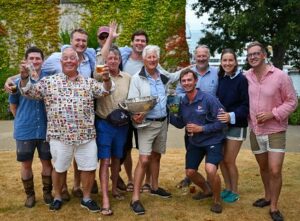
I have just spent the last 5 days racing my great chum David Aisher’s fantastic “vintage yacht, Thalia, at the 200th edition of the famous Cowes Week Regatta. This morning’s photo is the crew giving a salute to the Princess Royal, Ann (who fired the start gun), and yes, we had a piper playing Flower of Scotland on the foredeck. HRH is also president of the Scottish Rugby Union and was well impressed (or so we were told).
Each day the vintage fleet of yachts built before 1939 was given a course to race around the Solent – the stretch of water that separates the brutal reality of mainland Britain from the joy and delight that is the Isle of Wight. Built in 1888, Thalia was the oldest boat in the regatta yet managed to score a perfect 4 score – winning every race in her fleet over the four days of competition. It was some of the very best yacht racing I’ve done in years. Absolute nip, tuck and focus. 4 bullets is awesome.
Thalia is a racing gaff-rigged pilot cutter, built in Poole 138 years ago. David beautifully restored her after “finding” her on a Caribbean island about 15 years ago when the Icelandic volcano stopped transatlantic flights. All the ropes are brown and there are hundreds of them. “Pull the brown one” is funny a couple of times.
Our main opposition was an equally wonderful Cornish Pilot cutter called Cornubia built in 1911. She’s a proper blue-water yacht, looks fantastic and being slightly longer waterline length than Thalia, she carries a higher handicap. For every hour of sailing, Thalia was getting about 6 minutes from Cornubia. If she crossed the finish line first, we had some time to catch her up!
Rule One of yacht racing is the yacht and crew. Both have to be ready and prepared (perfect preparation prevents pi**ups) and Thalia is beautifully looked after. Each morning the crew would check their stations, the ropes, blocks and tackles — there are no winches or grinders on board. David had assembled a crew of youngsters from the Royal Yacht Squadron’s race team – a great bunch who largely hailed from the Island but are now pursuing careers on North Island as the mainland is known. Charlie, now in the City after 8 years in the Scots Guards, was a rather fine piper, but he didn’t know the 79th’s Farewell to Gibraltar (the march of the Cameron Highlanders, Scotland’s finest regiment.) The lads did all the pulling, hoists, drops and trimming of the three foresails and the spinnaker.
David, the owner, might be described as vintage himself, but you would never know it. He’s a teenager at heart. Seldom without a smile on his face, he skipped around the boat directing the crew on trim, hoists and drops, even dancing out on the bow sprit to fly the spinnaker. Marvellous chap who proves sailing keeps you young. (My wife describes him as the ultimate Silver Fox!) He understands every detail of his complex boat – and makes sure it all functions as it should.
At the back of the bus were the oldies, my dinghy sailing chum Phil (superb sailor) was steering, while Stephen (a former commodore of the Royal Ocean Racing Club) was on the main sheet. These are tough jobs – steering and trimming the main are grunty jobs. My role was navigation – checking the weather, tides and currents that determine the winners and losers in the Solent. I then had to apply that knowledge as we raced round the course we were given to race, calling the shots when the boat would tack or gybe to sail fast around “the marks of the course” – the buoys that litter the Solent. Using the tides and wind to best advantage. And on every tack, I’d wobble round the back of the boat to help the mainsail trim and the runners (ropes that keep the mast in place).
Rule Two of sailing is to have a plan. After decades of sailing on the Solent, I know how the tides run, and how the wind conditions will vary according to which way its blowing. Our crew has the experience to know to keep one eye on the boat (on our speed and sail trim) and other “out the boat” to spot the gusts of wind on the water, and where other yachts are. I make a point of running round the boat before the start, and when time allows during the race to explain the course and how we are doing to each crew member, so they know what to expect. It keeps them closely involved.
Rule Three is to be ready for the proverbial Tysonesque punch in the mouth, but not to let it destroy the plan. Surprises happen – especially on the start line. In the five minutes before the cannon announces the start, the yachts wheel around seeking the best starting position. We try to time our manoeuvres to hit the line at speed and with momentum bang on the gun. Twice we got it wrong and crossed a couple of seconds to oearly, earning ourselves a penalty which ate into our rating advantage of being a slower yacht. Not panicking when mistakes are inevitably made is critical.
When something snaps – don’t curse. Fix it. And keep going. And there is Rule 3 subsection b which states: if the plan isn’t working, figure out why and change it. Subsection c is about taking advantage of every mistake other boats make, and not making mistakes yourself – which means the plan has to be adaptable.
Rule Four is that experience can win races. The yacht raced closest against each day, Cornubia, was a well sailed as Thalia, but didn’t have a crew who knew the Solent like we did. They sailed faster, but often didn’t realise they’d missed a tidal lift, or had sailed into a wind shadow (like the infamous Norris Nadgers where the winds turn very squirrelly) till it was too late. We punished these mistakes ruthlessly. Local knowledge is important – it wins races.
Our 4 wins out of 4 races sounds like a convincing win where we dominated the opposition, but it was much closer than that. After every race we’d sail up alongside Cornubia and give them three cheers, which they reciprocated. Sounds a bit old fashioned, but exactly the right thing to do. Beers shared in the sailing club later.
As we sailed back to our berth after racing the crew would be dancing on the deck to Charlie on the pipes. We’d pack the boat away, making sure it was ready for the next day, and then the party started… Yesterday David picked up the rather marvellous trophy and a lot of champagne got drunk before David and I finally sailed the boat back to Hamble. (The other classes at Cowes week race right through to Friday).
Tomorrow back with some proper financial market kind of stuff…
Out of time and back to the day job…
Bill Blain
Author of the Morning Porridge
CEO Windshift Capital
Advisor – Spitfire Strategic Capital
Meanwhile, don’t forget about my new book:
You can read a review on the Society of Professional Economist’s website here.
The Battle for Hamble is a proper grown-up examination of how economies fail: a tale of Greedy Corporates, Bad Planning and Economic Illiteracy. It uses a wholly unnecessary Gravel Quarry in the middle of a prosperous village to illustrate the multiple failings and abdications of responsibility that have created Broken Britain. It’s about bureaucracy, money, exploitation and shareholders vs stakeholders. It’s about social injustice – asking why it’s ok to put 6000 jobs at risk so corporate bosses can reap bigger bonuses! Whether is the Hamble Quarry, HS2 or the abysmal state of UK armed forces due to bad procurement, read the book to understand how its broken process and bureaucratic indifference that is sinking Britain.
2 Comments
Comments are closed.

Great to read about your Cowes week sailing with David Aisher. I did my first ever RORC offshore race on with him on his Yeoman XXVIII back in 1996! And we won our class!
Congratulations to you and the Crew,
Well Done and an excellent bit on what it takes to win